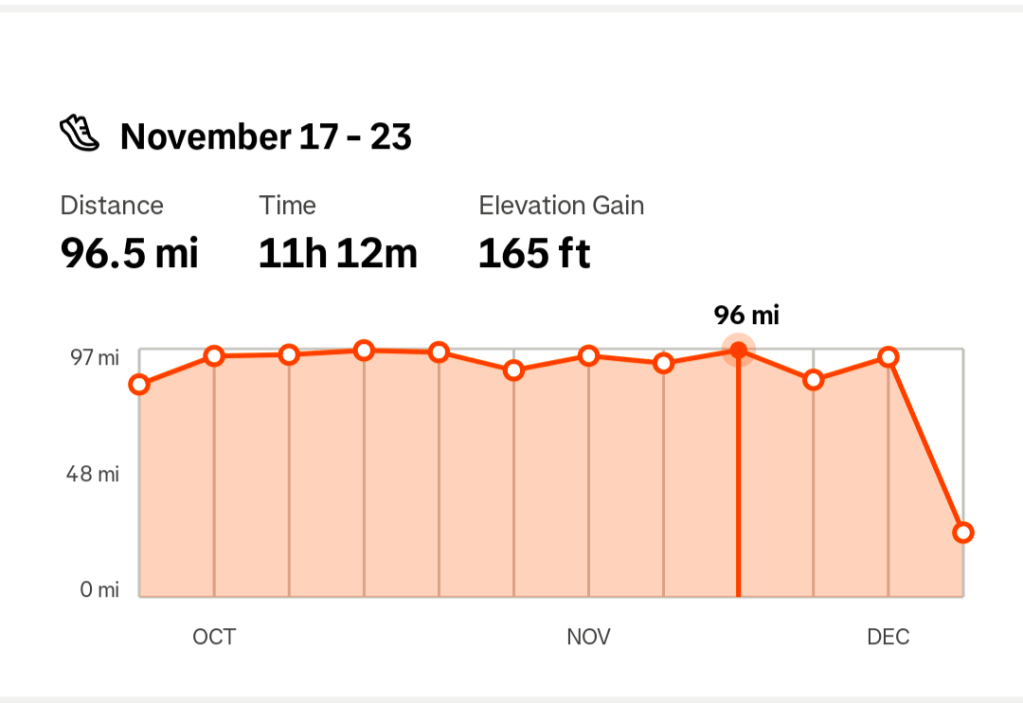
Maybe you’re not trying to run 100 miles a week (most runners aren’t!), but there are huge benefits to nudging your weekly mileage upward. More aerobic capacity. More durable muscles and tendons. Better running economy. And perhaps the biggest perk- when you run more consistently, your body becomes far more prepared for intense training later on, like during marathon prep.
So how do you know the right amount of weekly miles for you? And how do you build safely without flirting with injury? Let’s break it down, PLUS grab your free base-building plans at the end of this guide.
How to Find Your Ideal Weekly Mileage
Running volume is deeply personal. The “right” number isn’t something you grab from a chart or your running buddy. It depends on your injury history, current training load, how many years you’ve been running, and even your work or school schedule.
Some runners are naturally durable and thrive when mileage goes up. Others need a more cautious ceiling, or a blend of running and cross-training. And if you’ve been running consistently for years, your tendons, bones, and soft tissues are better prepared for mileage than someone newer to the sport.
Also consider your lifestyle outside of running. If you’re on your feet all day or have a physically demanding job, that stress counts too. Your body doesn’t separate “running fatigue” from “life fatigue.” It all goes in the same bucket.
Time on Feet vs. Miles and Why Both Matter
Mileage is only half the story. Your time on feet is the other. A faster runner can cover more distance in less time, while a slower-paced athlete is out there longer and accumulating more stress.
As a general guideline, many runners make their best gains with 10–12 hours of running per week. Much more than that and fatigue can creep in fast. So while mileage is the number we all obsess over, keep an eye on how long you’re actually running each week.
A Smarter Way to Build Mileage (Without Injury)
To safely increase mileage, slow and steady truly wins. The classic 10% rule is a great starting point—if you’re running 30 miles per week, bumping to 33 next week, then 36–37 the week after, is a gentle and sustainable build.
We also recommend building for 2–3 weeks, then taking a “down week”—a deliberate reduction of roughly 20–25% (we go deeper on this in The Art of the Down Week). Down weeks give your body the breathing room it needs to adapt and come back stronger. Repeat this build-rest rhythm and your weekly mileage will rise without pushing you into the red zone.
Should You Run Doubles?
Doubling (or running twice in one day) can be a surprisingly effective way to increase volume without overwhelming your body. Two shorter runs usually create less stress than one long grind that leaves you wiped out.
A simple guideline: if a run is going to take longer than 60–90 minutes (aside from your long run), consider splitting it. A common split is 2/3 of the mileage in the morning and 1/3 later in the day—for example, 8 miles early, 4 miles in the evening.
Just make sure you give yourself at least four hours between runs so your legs get a meaningful reset.
Warning Signs You’re Doing Too Much
As your mileage climbs, expect a bit more fatigue or general soreness. That’s normal adaptation. What’s not normal is sharp pain, swelling, or lingering niggles. If anything feels off, scale back immediately. A few rest days or a light week now is far better than six weeks on the sidelines later.
It also helps to reduce speed work during big mileage builds. Keep workouts light, with lower intensity and lower volume. Base-building season is the perfect time to focus on aerobic development, not PR-chasing.
Free 10-Week Base Plans to Elevate Your Fitness
We’ve helped countless runners safely increase their mileage and unlock breakthrough races as a result. Whether you’re starting around 20 miles per week or eyeing a serious high-mileage build, we created three free 10-week Base Training Plans to help you get there. Download your plan here:
Then subscribe below to get weekly training tips from our coaching team. Simple, actionable advice to help you run stronger, faster, and with more confidence.


Leave a Reply