Your goal race is a few months away, and you’re motivated to run faster than ever. Naturally, you might assume that the key to improvement is simple: run your workouts faster every week.
Unfortunately, that’s not how fitness works.
Many runners make the mistake of constantly chasing faster splits in training. While that approach may feel productive, it often leads to workouts that no longer target the physiological systems they’re intended to develop. Instead of building fitness efficiently, you end up working harder without necessarily getting better.
The smarter approach is to train at paces that match your current fitness level and gradually increase the challenge in other ways.
Why Faster Isn’t Always Better
Training paces are designed to target specific energy systems in the body. Depending on the workout, you may be developing aerobic endurance, lactate threshold, VO2 max, or race-specific fitness.
When you run significantly faster than your current fitness supports, you begin training a different system than intended. For example, a workout designed to improve 10K fitness may become more like a 5K workout if the pace is too aggressive.
Instead of forcing the pace, allow your fitness to improve first. As your fitness improves, your training paces will naturally become faster.
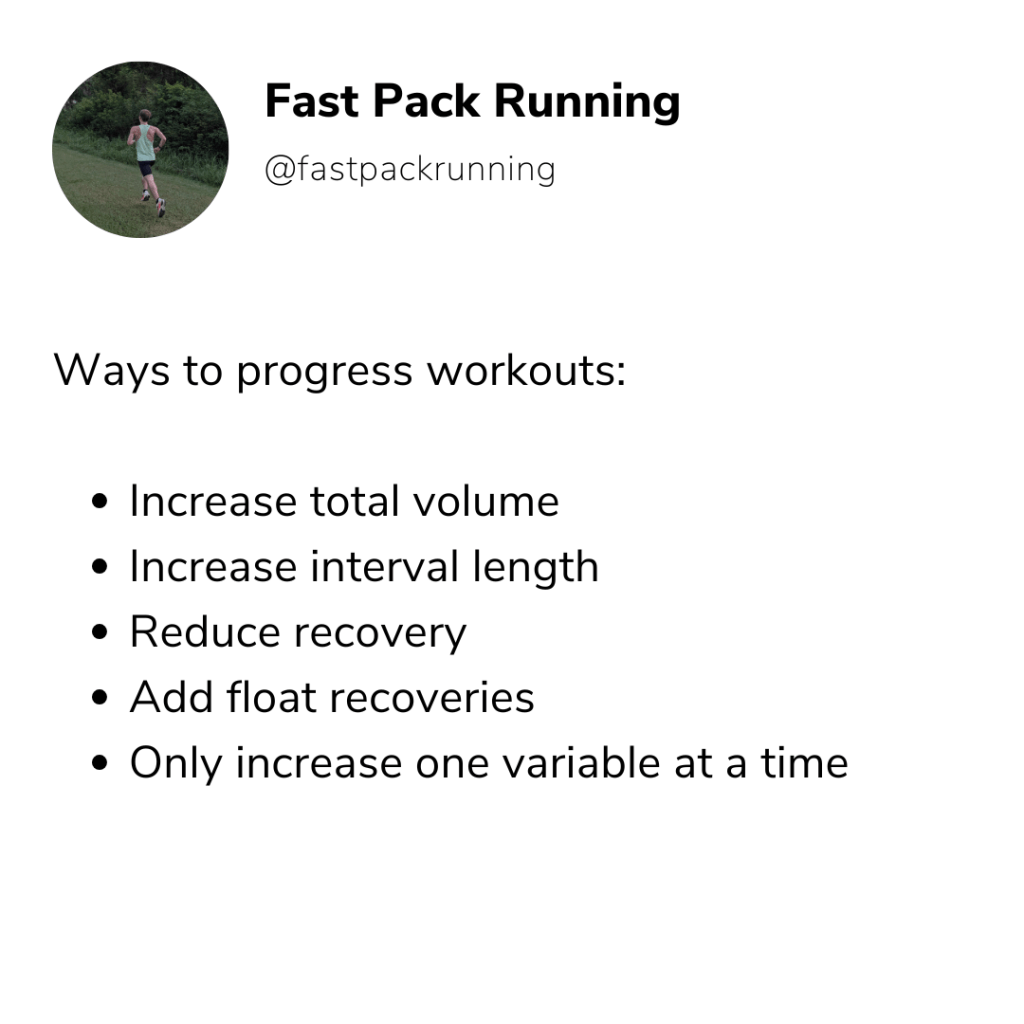
Four Ways to Progress a Workout
If pace remains relatively constant, how do workouts become more challenging? By manipulating other training variables.
1. Increase the Total Volume of Work
One of the simplest ways to progress a workout is to increase the total amount of running performed at your target pace.
This can be done by:
- Adding more repetitions
- Adding more sets
- Increasing the total distance covered at race pace
More volume allows you to spend more time training the intended energy system, creating a greater fitness stimulus.
2. Increase the Length of Each Interval
Another effective progression is to make the intervals longer. Longer intervals teach your body to sustain a pace for extended periods while maintaining good running economy and mental focus.
For example, progressing from 800-meter repeats to mile repeats at the same pace helps build the ability to hold that pace longer before fatigue sets in.
3. Reduce Recovery Between Intervals
As fitness improves, you can shorten the recovery period between repetitions.
Reducing recovery forces your body to become more efficient at clearing fatigue and recovering while still under stress. This creates a more race-specific challenge and prepares you for maintaining pace when you’re tired.
4. Use Float Recoveries
A float recovery is a controlled recovery run performed between intervals at a pace faster than an easy jog. Instead of completely recovering, you continue moving at a moderate effort before beginning the next repetition.
This creates a more continuous workload and closely mimics the demands of racing, where you rarely get the opportunity to fully recover.
Examples of Race-Specific Workout Progressions
5K Training Progression
Week 1:
- 12 x 400m at 5K pace
- 200m recovery between reps
Week 2:
- 2 set of (3 x 800m at 5K pace)
- 200m recovery between reps
- 400m recovery between sets
Week 3:
- 2 x 1600m at 5K pace with 400m recovery
- 2 x 800m at 5K pace with 200m recovery
Week 4:
- 3 x 1600m at 5K pace
- 400m recovery between reps
Notice that the pace stays the same while the intervals become longer and more demanding.
10K Training Progression
Week 1:
- 8 x 1K at 10K pace
- 200m recovery between reps
Week 2:
- 5 x 1 mile at 10K pace
- 90-second jog recovery
Week 3:
- 4 x 2K at 10K pace
- 2-minute jog recovery
Week 4:
- 2 x 2 miles at 10K pace
- 3-minute jog recovery
- Followed by 2 x 1 mile at 10K pace
- 90-second jog recovery
As race day approaches, the workouts become more continuous and race-specific.
Half Marathon Training Progression
Week 1:
- 6 x 1 mile at half marathon pace
- 1-minute jog recovery
Week 2:
- 3 x 2 miles at half marathon pace
- 2-minute jog recovery
Week 3:
- 2 x 3 miles at half marathon pace
- 3-minute jog recovery
Week 4:
- 6 miles continuous at half marathon pace
This progression gradually bridges the gap between interval training and sustained race effort.
The Goal: Build Fitness, Not Force Fitness
The purpose of a training plan isn’t to prove how fit you are today, it’s to build the fitness you’ll need on race day. The best workout progressions don’t require you to run faster every week. Instead, they gradually increase the training stimulus through volume, interval length, recovery manipulation, and workout structure.
Trust the process. Train at the paces that match your current fitness, progress the workload gradually, and you’ll arrive at the starting line ready to run faster when it matters most.
If you’re unsure how to structure your workouts or progress your training from one phase to the next, working with a coach can help remove the guesswork. At Fast Pack Running, we create custom training plans tailored to your fitness level, schedule, and race goals so you can train smarter and arrive at the starting line confident and prepared.


Leave a Reply